



 0
0

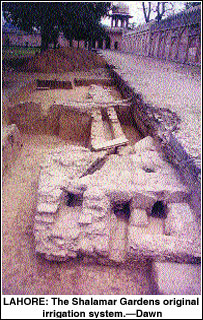 LAHORE, March 7: The archaeological excavations at the Shalamar Gardens have failed to establish that the monument’s lawns were originally further sub-divided into four quadrants and that there had been no less than 16 sub-gardens on the upper terrace.
The first excavation of its kind anywhere in a Mughal monument, however, revealed an excellent irrigation system linking the main water courses with the three-tier hydraulic system from three sides. The system comprised covered drains, terracotta pipes and channels made of country brick masonry.
There were primary underground water channels beneath all the walkways that released water into the gardens with a thrust. An important feature of the system is that it was designed to help chilling of the running water in summer.
The excavations at the 17th century monument was carried out, in collaboration with the United Nations Educational Scientific and Cultural Organization, primarily to find out the original landscaping, layout of gardens and their flora.
Beginning in the first week of January, the excavation was also aimed at substantiating the belief that each of the monument’s lawns was originally divided into four quadrants and that each of the terraces had 16 sub-gardens. The belief was possibly based on the comparison with Taj Mahal of Agra and the Shalamar Gardens of Kashmir (Gulmerg).
“This (tradition) has not been substantiated in the process (of excavation). What is more important is that we have found the Mughal period irrigation system,” architect Maqsood Ahmad, incharge of the Shalamar Gardens, told Dawn.
Another purpose of the excavations was the restoration of at least one of the gardens in the monument to its original layout and flora. Mr Ahmad said that the University of Engineering and Technology, the Government College, Lahore, and the Archaeology Department had worked out the plan together.
The find of the excavation so far seems to be that water courses ran underneath all the walkways and that they released water with a pressure watering the gardens to the right and left. Besides terracotta pipes, country brick water channels have also been unearthed.
The main source of water was the three-trier hydraulic system in front of the Shalamar Gardens which was demolished by the Punjab government in 1998 to widen the GT Road. Demolition of the system, designed by Emperor Shah Jahan’s canal engineer, Ali Mardan Khan, evoked worldwide protest and prompted the Unesco to declare the Shalamar Gardens an endangered monument.
One of the findings of the study was that — possibly on account of an analogy with the paradise — the gardens had more fruit trees than flower beds. The trees were grown in pairs. Date, peach, apricot, almond and pomegranate were some of their favourite trees.
Mr Ahmad said a plot on the upper terrace was being earmarked to develop the original flora and landscape.





























