



 0
0

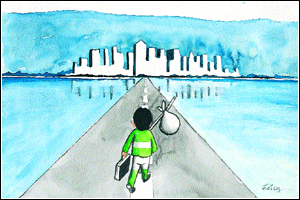 Finance Minister Shaukat Aziz, while speaking at the Euromoney Year Award presentation ceremony, said Pakistan was faced with daunting challenges after the September 11 episode and vowed to meet them successfully.
The press reports did not specify as to what were the daunting challenges and how he planned to respond to these challenges. One thing was, however, certain that he was referring to what could be classified as economic challenges and was not talking about the socio-political challenges, with which the country was faced with. According to him, economy had improved tremendously, after implementing positive reforms and now Pakistan was moving towards a direction of investment and growth.
There is no doubt that our economic situation is not as critical today as it was in October 1999. We have successfully come out of a collapse scenario, thanks to the active support of international donors. There are, however, many people and institutions that do not subscribe to the rhetoric of Shaukat Aziz. International donors are included in that group. For instance, Paul Chabrier, the IMF Director for Middle East and South Asia, in a recent press briefing, described Pakistan’s current economic situation in the following words: “generally balance of payment position has been improved, gross foreign exchange reserves increased to $ 5 billion, inflation checked and exchange rate mechanism has proved to be quite effective due to which rupee gained strength viz. a viz. dollar”.
The difference between the two assessments was quite evident. According to the finance minister, economy had improved tremendously since October 99. According to the IMF, the government was generally doing well. The difference in the two perceptions was, however, of no major consequence, as both agreed that the country’s economic scenario has changed for the better.
The main issue, therefore, with which Pakistan is faced today is not whether the IMF prescription has worked or it has not delivered and whether we had more options available to us to improve the economy and come out of the crises. This is a story of the past. The ground reality is that Pakistan has accepted the IMF prescription for the revival of the economy and trying to implement it and that it has saved us from an immediate collapse. The main issue is whether we can use the fiscal space made available to us by the international donors to put us back on rails. Whether we would be able to move in the direction of investment and growth, from now onwards or continue to survive on the charity of international donors, to which we have become so accustomed?
There are strong indications that the present government is going to stay for next few years. Hence, the present IMF -led economic management policy has come to stay. This is the price that the nation and the government is going to pay for the rescue operations made by the donors in last two years. This is evident from the PRGF conditionalities accepted by Pakistan, which do not deal with how the poverty would be reduced and growth assured over the next three years but how the government would behave in its relationship with the economic management.
The economic management policy is therefore not the new challenge in post-September 11 scenario. It is given. The IMF is going to take care of it. The IMF, the World Bank and the bilateral aid can save a country from financial collapse and keep it floating for some time, but they can not ensure a self-sustaining economic revival and growth. This is an structural deficiency in the external support system. The history of economic development shows that sustained economic growth comes from within and not from the outside. The external factors can help but they can not ensure a better future for a country.
The post-September 11 challenge for Pakistan, therefore, is not in evolving a new economic management policy, as we can not afford to do so in the medium term. This is not an option. Such policy would be dictated to us by the IMF technicians who have been assigned this role by international donors community. The challenge lies in doing something from within which is not contrary to the IMF prescription but which could put us back on rails, reduce our future dependence on external assistance, provide us the strength to survive and live as a respectable nation.
The question thus arises: what can be done from within which is not contrary to the IMF prescription but at the same time helps us to stand on our feet. To find out a proper response to this question, we should determine what is the basic disease we had been suffering from over the last many years. In my view, it is the poor quality of governance, which has penetrated into the veins of the society and made it sick. Governance has exhibited itself in a number of ways. Budgetary deficit, ineffective law and order, unresponsive judicial system, undue emphasis on defence expenditure, over-regulation of business and industry, and lack of accountability are only a few of the indicators of poor governance. Perhaps it is not possible to prepare a comprehensive list of the ways in which poor governance has exhibited itself in this society. All these issues are not economic issues. They are management or governance issues, and unless these are resolved there can be no entrepreneurship and no innovation, whatever be the economic policy. This is the prerequisite of growth. Kunwar Idris, has put it in a lay man’s language as: “most official organizations in Pakistan end up by paying their employees and not serving the public”. Can this process be reversed to make the society productive and self-generating in an indigenous way?




























