



 0
0

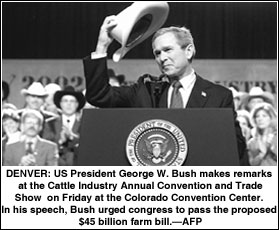 DENVER, Feb 9: President George W. Bush warned the Senate to drop big-spending “political gimmickry” in from its farm subsidy overhaul on Friday because it would cheat growers in the long run.
The Senate was in the final days of debate on a $45 billion farm bill likely to pass without any of the changes sought by the administration. The bill would raise crop supports — a bad idea in the White House’s view — and boost grain, cotton and soyabean subsidy spending by $5bn a year.
Once passed, the five-year Senate bill must be reconciled with a 10-year, $73.5 billion House-passed bill that was more to the administration’s liking. The final version will go to Bush for enactment. Congress has earmarked $73.5 billion for new agricultural spending through 2011.
We’ve got to spend that money without. I guess you would call it, political gimmickry, Bush told the National Cattlemen’s Beef Association convention. The $73.5 billion should be spent “relatively evenly,” he said, not bunched into a few years, as the Democratic-drawn Senate bill would do.
In other words, to put it bluntly, what we don’t want to do is over-promise to farmers and under perform (because funding ran out too soon), the president said, to applause.
Bush used the speech to reiterate administration goals for the new farm policy law. The include holding the line on crop supports, encouraging larger farm exports, financial rewards for land stewardship and creation of federally matched savings accounts to help growers through hard times.
Senate Agriculture Committee chairman Tom Harkin, Iowa Democrat, said Wednesday farmers needed relief now, so it was appropriate to “front load” farm-bill spending.
I want to bring the farm economy up now. We need it now, Harkin told visiting National Farmers Union members.
Private consultant John Schnittker, an Agriculture Department official in the Johnson era, dismissed the speech as “mostly boiler plate.” A House Agriculture Committee staff worker said it would ensure White House leverage in the final House-Senate negotiations on a farm bill.—Reuters




























