



 0
0

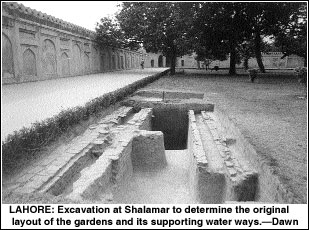 LAHORE, Feb 8: Trenches have been dug in some parts of the Shalamar Bagh to determine the Mughal period layout of its various gardens, the original flora and details of the irrigation network.
Funded by the United Nations Educational, Scientific and Cultural Organization, the project aims at restoration of the flora, initially, of one of its gardens, the way it was grown by gardeners of Emperor Shah Jahan.
This is the first effort in Pakistan to learn about the Mughal horticultural patterns.
The project aims also at determining whether the Lahore Shalamar was indeed divided into 16 smaller gardens like the Taj Mahal, Agra, and Shalamar Gardens in Gulmarg, Kashmir. Sikh era evidence suggests that it is indeed so.
The lawns on both the upper and the lower terraces have been dug as deep as five feet. The preliminary investigations have exposed an irrigation network.
Institutional studies for the high-profile project, involving the World Heritage monument, will be carried out by teams of researchers from the Agriculture University, Faisalabad, the University of Engineering and Technology, Lahore and botany departments of the University of the Punjab and the Government College, Lahore.
The Archaeology Department team, headed by Muhammad Safdar, includes archaeologists, architects, excavators and chemists.
Maqsood Malik, a senior architect and incharge of the Shalamar Gardens, says the project is important in the sense that it will enable the researchers to draw the original plans of some of the Mughal period monuments.
He says that architects have been asked to draw the plans afresh.
At least one lawn, Mr Malik says, will be restored to the original form. This, he hopes, will lead to more studies.





























