



 0
0

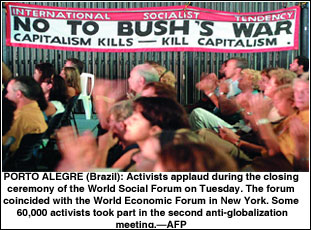 PORTO ALEGRE (Brazil), Feb 5: Thousands of people marched through Porto Alegre, Brazil, on Monday to protest a proposal for pan-American free trade as activists accused the United States of not playing by its own rules when it comes to international commerce.
The sea of red flags was the last scheduled show of popular strength at this year’s World Social Forum, which kicked off on Jan. 31 to coincide with the World Economic Forum in New York where world business and political leaders met.
The Brazil event began with a massive peace march and hosted a demonstration of solidarity with economically troubled Argentina. It will end on Tuesday.
Waving Mexico’s red, white and green flag, Alejandro Villamar said if anyone should know about the dangers of free trade, it is Mexicans, who have been part of the North American Free Trade Agreement with the United States and Canada since 1993.
The proposed Free Trade Area of the Americas would basically extend that down through to Argentina.
“FTAA is a superclone of NAFTA and we don’t want our Latin American brothers to suffer the same as the Mexican people,” Villamar, who is part of a 50-person delegation from Mexico at the forum, said in between chanting anti-U.S. slogans.
Caught in the world economic downturn, the Mexican economy is expected to have contracted in 2001. But it was surging before then, growing a robust 6.9 percent in 2000 in large part thanks to its exports to the United States.
But Villamar, who works for the Mexican Network for Action Against Free Trade, says that growth did not filter down to Mexico’s masses and that there is more poverty now than there was before the trade act.
Up the column of protesters, Peter Rosset of the California-based Institute for Food and Development Policy is one of the few Americans at the march. He agrees with Villamar.
“Somewhere between 25 and 60 percent — depending on whose figures you believe — of small and medium business (in Mexico) have gone bankrupt as a result of NAFTA. What this shows is a delinking between economic growth and peoples’ living standards,” he said.
Earlier in the day, a panel of grass-roots activists accused the United States of urging other countries to open their borders to U.S. products while keeping its own doors closed.
“They talk of liberalization when it is we that have to liberalize and they that are protected,” said Roberto Bissio of Uruguayan group Social Watch.—Reuters





























