0
0

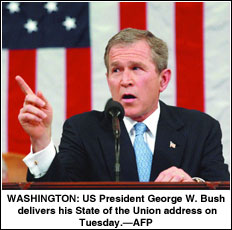 WASHINGTON, Jan 30: In a State of the Union address to Congress that sounded like a war-time speech, US President George Bush on Tuesday night grouped Iran, Iraq and North Korea into what he called an evil axis and said the US would not permit the “world’s most dangerous regimes to threaten us with the world’s most destructive weapons”.
Emboldened by an unprecedentedly high wave of public approval for his handling of affairs since the Sept 11 attacks, Mr Bush used the occasion of the traditional yearly speech by the president to the US legislature to accuse the three countries of attempting to develop nuclear, biological and chemical weapons, virtually threatening them with pre-emptive action.
He did not specify steps he is likely to take, but said, ominously: “We’ll be deliberate, but time is not on our side. I will not wait on events while dangers gather.”
Apart from the threats hurled in strong language at Iran, Iraq and North Korea and a commitment to continue the “war against terror”, the 48-minute address, which came at the end of Mr Bush’s first year in office, was bereft of any references to international issues, such as the Palestine question or the confrontation in South Asia and contained no indication of new US initiatives in tackling global poverty and deprivation.
The portion of the address concerned with foreign affairs was almost entirely devoted to terrorism. Iran is staunchly opposed to the Taliban regime and Osama bin Laden, and Mr Bush’s harsh language against that country would be seen by observers as specially disturbing.
Watched from the presidential box by Afghan interim leader Hamid Karzai, currently on a visit to the US, Mr Bush said: “Our military has put the terror training camps of Afghanistan out of business, yet camps still exist in at least a dozen countries. A terrorist underworld - including groups like Hamas, Hezbollah, Islamic Jihad and Jaish-i-Mohammad - operates in remote jungles and deserts, and hides in the centres of large cities. My hope is that all nations will heed our call and eliminate terrorist parasites who threaten their countries and our own.”
In this context, Mr Bush praised President Pervez Musharraf, the only foreign leader other than Mr Karzai cited by name in the address. He said: “Many nations are acting forcefully. Pakistan is now cracking down on terror, and I admire the strong leadership of President Musharraf.”
In a generalized comment on how a “common danger” was erasing “old rivalries”, Mr Bush said: “America is working with Russia and China and India in ways we never have before to achieve peace and prosperity. In every region, free markets and free trade and free societies are proving their power to lift lives. Together with friends and allies from Europe to Asia, and Africa to Latin America, we will demonstrate that the forces of terror cannot stop the momentum of freedom.”
Towards the end of the address, which was repeatedly interrupted by applause, President Bush, implicitly acknowledging reservations in the Muslim countries about the manner in which the military campaign against “terrorism” is being conducted, said: “No people on earth yearn to be oppressed or aspire to servitude or eagerly await the midnight knock of the secret police. If anyone doubts this, let them look to Afghanistan, where the Islamic street greeted the fall of tyranny with song and celebration. Let the skeptics look to Islam’s own rich history, with its centuries of learning and tolerance and progress.”
He said America would take the side of those who advocated civil liberties and human dignity, including those in the Islamic world, because the US sought “a just and peaceful world beyond the war on terror”.
On the domestic front, Mr Bush made no specific allusion to the Enron collapse, which has brought into question the failed energy corporation’s ties with the Bush administration, and contented himself by saying the war on recession would also be won like the “war against terrorism”.
Democratic members of the two legislative houses remained seated during Mr Bush’s remarks on the economy, while Republican Party senators and representatives repeatedly stood up in their seats to give him a standing ovation, sometimes clapping and rising even on simply one sentence, although the speech to outside observers seemed to be stronger on rhetoric than substance.
Also in the presidential box was Afghanistan’s minister for women’s development, Dr Samia Samar, who is accompanying Mr Karzai on the Afghan leader’s visit to the US. Mr Karzai was a sober, dignified figure in his green cape and shalwar-kameez.