0
0

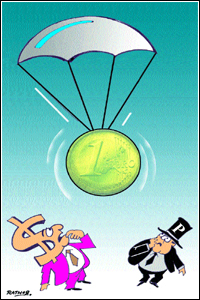 With the coming into circulation of euro notes and coins in the 12 countries of the European Union that have opted to join the common currency, has unfolded the historic final stage of European Monetary Union (EMU).
The national currencies will co-exist with the euro for six months and thereafter financial transactions will be possible using the euro only, probably the first time since the Roman Empire that Europe will have a common currency.
The European Monetary System (EMS) was established in 1979 to stabilize currency exchange rates among European Common Market countries. It established the Exchange Rate Mechanism (ERM) in Europe that restricted the amount of fluctuation against each other’s currencies among the member states. The objective was to promote trade and investment among them.
The weaker currencies were linked to the strong and stable German Deutsche mark to keep inflation in control and a common European Currency Unit (ECU) for accounting and administrative purposes was introduced that was highly successful in the 1980s.
The ECU was replaced by the euro when European Monetary Union [EMU] was formed on January 1, 1999, and the conversion rates between the euro and participating national currencies fixed and used to regulate exchange rates between the euro and the EU states that did not join the single currency, viz. Great Britain, Denmark and Sweden. With the introduction of the euro notes and coins, the 12 member states of the euro zone, with a population of about 300 million, almost 15 per cent of the world GDP and 20 per cent of the world trade, — comparable to the United States and significantly larger than the Japan —have moved closer to full European economic and monetary integration.
Only Britain among the major European countries is out of this euro zone. Opinion in Britain about joining or not joining the euro is divided, centred around the worry that there would be increased unemployment if the UK joins the Euro.
On the other hand, there are the fears that many big companies may pull out of the UK if it did not join. An adverse impact on foreign investment within Britain is feared. However, while the Conservatives were totally against joining the Euro, the policy of the labour party is a cautious one, but before Britain could join, there would be a referendum to decide the question. Some consider the staying out of the EMU as more irrational — a hangover from the days of the Empire.
The process of monetary integration has evolved gradually. The intergovernmental conference (IGC) at Madrid in June 1989 finally led on, in 1991, to the Maastricht Treaty. The elimination of exchange controls and restrictions on the flow of capital were accepted at the IGC as the first stage of the EMU. During the second stage begun in 1994, member states began to coordinate their economies to reduce inflation and budget deficits.
The European Commission had listed, in 1990, increased transparency, more competition, and a better division of labour in Europe, as the expected economic benefits of the euro for the participants. Now the historic process of full European monetary integration has indeed begun.
Since the Germans wanted the single currency to be as strong as the Deutsche mark, the EU countries entering this stage of economic integration have had to meet strict criteria on the size of government deficit, interest rate levels, inflation, and currency stability. The countries joining have thus surrendered some of their independence in economic policy in the interest of the monetary union. The ECB (European Central Bank) as been entrusted with the key task to maintain price stability and implementing a common monetary policy that in effect means setting interest rates for the whole Eurozone economy.
The expected benefits, however, include the promotion of the development of: (a) European capital markets, (b) private and government bonds and (c) equities. The process has not been entirely smooth. There have been difficulties on the way. In 1992-1993, Italy and Britain had to leave the Exchange Rate Mechanism, and slide into economic recession due to currency speculation. Many governments had to struggle to control inflation and budget deficits through cuts in government spending and other such measures, that often led to higher unemployment and popular discontent. In response to these difficulties, qualification criteria were relaxed in some cases. Greece, for example, had to be treated leniently in order to be able to meet the criteria for joining the EMU.
The Economist had written at the time of the launching of the euro in January, 1999: “Europe’s new currency got off to a smooth start, but questions over fiscal policy leave no room for complacency. Barring unforeseen disasters, the euro’s first challenge may well centre not on the currency itself but on fiscal policy.” ( The Economist, January 9, 1999) This was a reference to the European Monetary Union’s ‘Stability and Growth Pact,’ which calls for limiting public borrowing, geared to preventing fiscal policy becoming too eased after the forging of the monetary union but the net result, given too strict enforcement of rules, would have been a dangerously tight fiscal policy.
The euro has created huge and highly liquid financial markets, with a wide range of financial services that would benefit EU companies. The large volume of international capital flows that formerly dominated the flow of trade exposed the economies of the countries to exchange fluctuation risks. European businesses are now better protected from financial crises in different parts of the world.
European countries in general have more regulated economies than the US. Government spending is, on the average, 50-60 per cent of the GDP with corresponding high tax rates to finance welfare programmes. Labour unions are strong, worker benefits extensive and capital and labour mobility within Europe is yet limited. Another feature is the greater use of public sector enterprise industrial policies to nurture national industries, relatively open trade regime within Europe and open policies towards foreign direct investment (FDI), which means that long-term issues of fiscal burden of a large welfare state exist. Welfare system supports the unemployed and guaranteed jobs and high real wages in a number of industries mean that there has to be a high tax burden.
Impact on dollar: At present, the preferred currency for international transactions in the world economy is the US dollar. It is used also as a reserve currency by most countries’ central banks and monetary authorities to back up their own domestic financial system, and it is recognized throughout the world as the store of value of last resort, one reason for this being the size and strength of the US economy. Will the euro affect this role?
The value of the US dollar stems from its high demand for international transactions. This has put the United States at an a advantage, and it has been able to run large trade and budget deficits without major adverse effect on the value of the dollar. The US companies as well as governmental institutions have been able to borrow at more attractive rates than would otherwise have been possible. Now the advent of the euro has brought the first real competitor of the dollar on the scene to claim a place as an alternate reserve currency of choice.
The main reason for this possibility is that the EMU is a single-currency economic block of a size comparable to the United States, and is expected to follow stable economic policies. Secondly, the launch of the euro is likely to decrease the cost of transaction within Europe, and following more attractive borrowing by European companies, improve their competitive position vis a vis the US companies. In fact the international trade share of Europe is already greater than that of the US. Then the possibility of more countries opting for the euro within Europe exists. Yugoslavia and Montenegro have already adopted it as their currency, even though they are not members yet of the EU. In Middle East and Africa, it is likely to come into increasing use in international trading and if the current US ‘war against terrorism’ continues, there is every possibility of even a preferential response to the euro by parts of the Middle East and Africa, though its use as the currency of choice for the primary commodities including oil will take some time, if at all it does so in the near future.
How far the European Central Bank is able to muster up the power to maintain the soundness of the EMU system, as compared to the Fed [Federal Reserve Board of the United States], by, for example, acting as a lender of last resort and increasing money supply by issuing more Euros to tide over liquidity crises, only time will show. The EU obviously lacks the monolithic nature of the United States, but the will to act as an economic rival to the US is particularly strong among the EU member states, and should not be under estimated.
As long ago as June 2000, the Economist had predicted demand growth in the euro area at a faster rate than in the United States. (The Economist, June 3, 2000, p. 88.) However, beyond the benefits of enhanced liquidity, lower transaction costs and the elimination of within-European Monetary Union currency risk, many experts thought it unlikely that the euro would have a significant impact on international asset prices, risks and returns in the present system because in their view, international financial markets would remain subject to the large and dominant impact of the currency risks associated with the US dollar.
The floating of the euro as a store of value as against its use merely for invoicing and billing — as in the period 1999-2002 — will certainly increase its value against the dollar, but if the growth rates in Europe do not show the expected rise, it may lead to a coming loose of fiscal policies among the member states. Another risk for the euro’s strength as a currency is political conflicts within Europe which may be in many forms, not necessarily outright war.
The advent of the euro fundamentally underlines the phenomenon of the trading blocs becoming even more entrenched in the world than before. While the euro may offer an alternative currency of value, it does point to the need for the developing countries to organize themselves better in groups advantageous from the economic and trading point of view. For Pakistan, two obvious regional groups to participate in for mutually beneficial economic relations can be the Economic Cooperation Organization [ECO] at one level and a SAARC, activated in the field of trading and regional economic cooperation, at another. Considering the current political scenario, however, it seems to be still a far off dream.