0
0

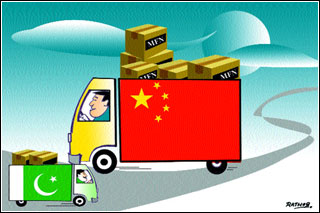 WITH an economy of the size of over one trillion dollars (to be exact $1.16 trillion), a growth rate of 7.5 per cent in the year 2001, exports of $250 billion plus a year, and an annual import demand of about $240 billion, the entry of the Peoples Republic of China as 143rd member of the World Trade Organization (WTO) in December last offers challenges and also unfolds immense opportunities for us in Pakistan.
China will now enjoy the most favoured nation (MFN) status with all the 144-member countries of the WTO including her adversary Taiwan. China has also signed a bilateral agreement with the USA giving access to a variety of her goods and even services.
A challenge has already come recently from China in the form of virtual dumping of footwear that has started hurting Pakistan’s footwear industry. “We are monitoring the situation” Razzak Dawood informed the journalists more than a week ago at a press briefing at the Export Promotion Bureau when he was told about Pakistan’s market being flooded with cheap Chinese footwear.
Pakistan faces this situation at a time when there is a complete breakdown in the commerce ministry. Businessmen say that there is absolutely no coordination between the commerce minister and the secretary of the ministry. The chairman of the Export Promotion Bureau is a direct nominee of the highest and the mightiest of the country and he has adopted a couldn’t-care-less attitude when it comes to maintaining a liaison with the commerce secretary and the minister. He does not meet exporters. “The EPB has become an export prevention bureau”, a frustrated exporter remarked. In last two years, the commerce minister has always been the lonely figure in a few press briefings that he held at Karachi. The EPB remains oblivious of the problems of footwear industry in Pakistan.
Local footwear dealers confirm of their business getting a big setback because of what they say flooding of the footwear from China and Korea. “These are of pig leather”, a well known local footwear with a popular brand name informed this correspondent. “But you cannot say that China has dumped footwear in Pakistan market”, another leading footwear manufacturers from Lahore said. He said the bulk of Chinese footwear are either being under-invoiced or are being smuggled through known routes. Chinese have set up big warehousing facilities in Jabal-e-Ali in Sharjah from where a lot of goods are making their way into Pakistan.
The official import figures of Chinese footwear is very small and insignificant and therefore cannot be called ‘dumping’ is one explanation. The Lahore footwear manufacturer explained that local production cost is high because the import tariff on shoes and components of shoes is by and large equal. The principle of cascading has been totally disregarded in matter of footwear imports and government refuses to offer a protective margin to the local shoe industry.
China is all set to give a very tough time to Pakistan’s textile marketing in EU and North America. “Whatever gains we achieved in EU from tariff concessions have been eroded by the recent appreciation of Pakistan rupee value against dollar”, Shabbir Ahmad a leading textile exporter remarked. There is also a sharp fall in the exchange value of a number of European currencies after the flotation of Euro, putting Pakistan’s exports at a disadvantage in those markets.
Therefore at stake is more than 4$ billion annual export trade of Pakistan in the USA and EU countries which is now vulnerable to relatively much cheaper goods from China. “Take care you guys, China has already started giving us a tough time in the US and EU market”, a manager of a textile unit in Jabal-e-Ali tax free enclave in Sharjah rang up this correspondent recently to inform that he was finding much difficult now to sell his security apparels in the European and US markets. Chinese are taking over there with their aggressive marketing techniques.
“Plant economy and a buoyant domestic market are the two factors that makes China an invincible competitor in the export market”, Sheikh Jawaid Ilyas Chairman of Pakistan-China Business Council told this correspondent. “It is an integrated production process under one roof and that too on a massive scale as compared to us”, he explained to point out that these two factors considerably bring down the production cost. Then there is a huge domestic market of 1.3 billion population. “Chinese are now pretty good consumers and are developing tastes for good things in life”, he said. Low production cost and a highly supportive domestic market gives Chinese entrepreneurs a big margin to operate in the export markets world over.
According to Sheikh Jawaid Ilyas Pakistani traders lack knowledge about the Chinese business. “It is no more state controlled business”, he said. “Chinese businessman is far more aggressive and dynamic than many of his competitors in other countries”, Javed Khalili a trader said.
The EPB was given the task to organise a seminar in Karachi to inform the businessmen of techniques to develop linkages with the Chinese business. It is now more than two months that the EPB has not responded to this proposal.
“China is one country with which Pakistan has the highest number of trade disputes”, a trader in the Karachi Chamber of Commerce and Industry informed this correspondent. Shaikh Jawaid Ilyas, confirmed that there were many trade disputes. He said that a business dispute resolving committee”, comprising four representatives drawn each from the FPCCI and the apex body of China CCPIT have already been formed. “Now we have to develop a modus operandi of this committee”, Zahid Umar, Vice Chairman of the Pakistan China Business Council said. He said that the Council has already held its first session and is holding next session in Beijing in April when the modus operandi of the Committee is expected to be finalized.
Chinese businessmen have proposed to set up a Silk Park in Pakistan. A Chinese delegation is expected to visit Pakistan in March to explore using Pakistan-made silk for value addition by way of embroidery and stitching garments for onward exports. The Chinese also want to use Pakistan made fabrics for readymade garments export.
Jawaid Ilyas, Zahid Umar and Javed Khalili are the second generation traders having business links with China. Their families developed business relations with China more than 40 years ago and they are the most frequent visitors. All three perceive that India has made big inroads in China although, “China is Pakistan’s strategic ally for more than 50 years”.
In last more than 20 years Pakistan’s image in China has been badly tarnished. There were reports that quite a big number of Pakistanis and Afghans with Pakistan passport were arrested in China for carrying drugs. About two years ago a Pakistani Senator travelling on diplomatic passport was reported to have been detained in Beijing for two days. Traders who frequent China have many more stories to tell.
With the liberalization of the economy a class of unscrupulous businessmen have become active in China. In connivance with the border guards and Pakistani traders in north a lot of consumer items are being smuggled into Pakistan. China made locks and keys, table clocks, watches, medicines, chemicals, electronics, perfumes and a host of other goods are coming through land border near Gilgit.
While the official two-way trade is less than $1 billion a year, traders say that unofficial trade between Pakistan and China is more than $1.5 billion. A big leap of more than 100 per cent has led Pakistan’s export to swell to about $304 million last fiscal year. Imports from China were worth $525 million.
A significant development pointed out by the commerce minister is that Pakistan’s exports in bulk are now going directly to mainland China instead of routing it through Hong Kong. China has helped Pakistan in developing the basic heavy industries which are Heavy Forge and Foundry, Heavy Mechanical Complex, Heavy Rebuild Factory. That many of these factories are closed or partially operational speak of the apathy of Pakistan’s ruling elite. China is now engaged in 200 million dollars Gwadur port project.