



 0
0

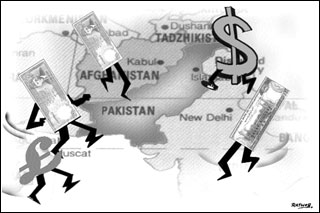 THE REMITTANCES of workers abroad has remained one of the most important components of the balance of payments (BoP) since late 1970’s.
During the 1972-73 remittances were merely $136 million but within a period of one decade it became the largest source of foreign exchange earnings, surpassing even exports in the mid-1980’s and had peaked at $2.9 billion in 1982- 83, which amounted to hefty 10 per cent of the GDP. The boom of 1980’s reversed in early 1990s, partially due to return of the Pakistanis from Kuwait and Iraq also due to the Gulf crisis besides the falling dollar value in Pakistan owing to dollarization in sharp contrast to flow patterns witnessed in other countries of the South Asia.
The failure of the banking system to attract remittances and the absence of appropriate actions by the government to address the grievances of non-resident Pakistanis during 1990’s, gave the hundi/hawala system ample time to establish a reputation among expatriate Pakistanis. It has greatly reduced the foreign exchange earnings from this mode and exerted great pressure on BoP. The policy-makers in the 1990 have failed to tap the potential of this very important source of foreign exchange earnings. the last straw on camel’s back was the decision of freezing the foreign currency accounts in May 1998. The impact was prompt and the officially remitted inflow declined from $1.2 billion in 1997-98 to $0.9 billion in 1998-99. Even the patriotic spirit of non-resident Pakistan mobilized through hectic campaign by GOP could not avert the declining trend in workers’ remittances.
The government took a number of steps to rejuvenate this important source of foreign exchange earnings and these included; reduction of minimum limit for reimbursement of the TT charges from $200 to $ 100, conversion of the money changers’ nomenclature into foreign exchange companies and the enhancing of the efficiency of banking channel. The SBP also tapped into the informal remittances through its outright purchases from the kerb market and commercial banks were persuaded to clear all remittance claims within 48 hours to attract the non-residents accustomed to the promptness of the hundi system.
The worth of all these measures seemed to have paid off when we look at 11.8 per cent increase in workers’ remittances during the 2000-01 and crossed the much-desired one-billion mark after two years (since the nuclear detonation in May 1998). However, they are still disappointing compared to the level achieved in remittances.
This inordinate inflow of cash remittances has opened new vistas and policy challenges for Pakistan. The problem with the Pakistani policy makers is that they have to accommodate new sources of capital in productive uses. There is likelihood that with this inflow of capital, the inflow of manpower will follow. Therefore, development of small and medium industry is key in the process of efficient utilization of this capital. Pakistani banks are also needed to improve their performance and cost effectiveness to attract aspirants of transferors of money back to their homelands. The prompt policy response to new openings should start from banking sector reforms and then into availability of new entrepreneur opportunities in the country. Banking sector should introduce new schemes for relatives of overseas Pakistanis.
There is a dire need to take all this very seriously; otherwise, at the availability of conducive environment in other parts of the world or availability of other sources domestically, like real estate or informal financial agents, the benefits would wither away. Sooner it would be the better. Pakistan missions abroad may mobilize a campaign to attract overseas Pakistanis to send their hard earned money to their homeland.




























