



 0
0

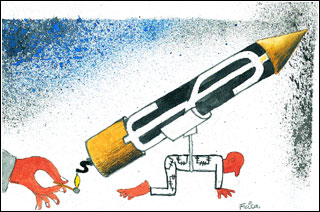 THE limited economic gains which Pakistan made in the aftermath of September 11 tragedy seem to be getting neutralized by the Indian military response to the December 13 terrorist attack on its parliament.
India has already counted its chickens and empowered its ministry of defence to impose a ‘war tax’ on consumer items without limit. So far there is no official word on what has been the impact of the defensive deployment that Pakistan has undertaken and what would it cost the country if the confrontation continues for another week, or month or six months or even a year and what would it cost to Pakistan in economic terms if the confrontation degenerates into a full-scale war.
While it is not possible to count the chickens before a war is actually fought, it should not be such a big and complex matter to estimate the economics of deployment which has already taken place and the daily cost of maintaining the three branches of armed forces in at the highest degree of alert.
India has estimated that it has cost New Delhi as much as Rs10 billion to position its armed forces at the Line of Control(LoC). Since the distance between our cantonments and LoC is not as much as that which the Indian troops have to traverse from their cantonments to the Indian side of the LoC, our cost of deployment at the LoC may not have gone beyond Rs2 to 3 billion. But then since we cannot rule out the possibility of a threat from across the international border we perhaps have also deployed troops at these borders also and this could have entailed an expenditure of another Rs5 to 7 billion. This would mean that our total cost of deployment at both the LoC and the international borders has perhaps not gone beyond Rs10 billion against India’s estimated Rs10 billion for deploying its troops at the LoC alone.
But then there is the daily cost of maintaining the three branches of armed forces at the highest alert. The Indians have not estimated this cost for their armed forces. And perhaps in this case too it would cost Pakistan at least about one tenth of what it would cost to India. However, going by the difference in the GDPs of the two countries the impact of the economic cost of the current Indo-Pak tensions to Islamabad’s financial ability would be almost equal to what it would be to New Delhi if not a little more. More than ten years ago when our armed forces undertook the peace-time war exercise of Zarb-i-Momin which had lasted for about ten days, it had cost the exchequer something like Rs1 billion. Today the purchasing power of the Rupee is at least three times less than what it was in 1988. And in that year about Rs20 used to fetch a dollar. Today it is about Rs.60 to a dollar.
Already the government is estimating a loss of about $3 billion to the economy this year due to the various negative developments taking place internationally and regionally in the wake of the launching of the world war against international terrorism following the September 11 tragedy. The most adverse of these developments has been the decision of the international shipping and insurance companies to designate Pakistan as part of the war zone—the only country to be designated so.
In importers’ countries the customers have also started showing aversion to goods from Pakistan which has reduced new orders and put on hold the previous orders. Large consignments sent before Christmas are still not being cleared by importers in America and Europe. The estimated losses as a result of all this which are still tentative include loss in production, declines in investments, exports and revenues. Even if this loss is adjusted to the gain of a billion dollar or so that we made in the aftermath of September 11 tragedy ( immediate cash grants from the donors and reprofiling impact on debt repayment) we are still in the red by about $2 billion.
Following the December 13 developments, a war does look imminent in the region. So the shipping and insurance companies will now have more legitimate reasons to push up their rates further which perhaps would completely nullify the gain of even the one billion dollars. Importers would be justified in cancelling order fearing disruption in supplies. And perhaps if the tensions continue for another couple of weeks, things would become even more difficult for Pakistan’s economy. And the total cost may even go beyond 5 billion dollars during the year. And this would set our economy even beyond square one.
This is perhaps what the Indians want. New Delhi perhaps believes that an economically down and out Pakistan would be only too ready to accept its political and military hegemony. The Indian rulers seem convinced that the donors who are at present keeping Pakistan afloat by providing it little crumbs now and then would use their economic hold in concert to complete the route.
India is not sparing any expenditure in its efforts to bring Pakistan down at this point. It is losing more by the loss of Pakistani airspace for overflights of Indian airlines than what it has made Pakistan to lose by locking up its airspace for the PIA. In a functional democracy which India is, it is never good politics to promote war frenzy and impose war related taxes what to speak of any kind of additional taxes. But then the Indian government seems to have decided to take this risk perhaps on the calculation that it has the political backing of its voters for the campaign. In the process the Indians have also reduced the value of Pakistan’s nuclear deterrence considerably because its objective appears not to provoke Islamabad into exercising its option of first use but to terrorise Pakistan to capitulate without the Indian armed force crossing either the LoC or the international border.
So, finally what seems to be happening is a war between two economies and not a war between two infantries, two air forces or two navies. This is what we did not prepare ourselves for. All these years we have depended on the economic and military doles of others both for keeping our economy afloat and our military sinews fully flexed. Every time saner people cried out for a change in the priorities they were either branded as unpatriotic or dismissed as people lacking in strategic thinking. The nation was misled into believing that its freedom can only be protected by the military might and even by acquiring the nuclear deterrence no matter what the economic cost.
We lost many good opportunities to set our economy on the right course in the last decade by continuing to fight two low intensity wars—one beyond its western borders in Afghanistan and the other beyond the LoC in the Indian-held Kashmir. And when everything seemed to be collapsing all around , those in this country who hold the sway on everything from planning to propaganda designated the decade as a lost decade and blamed the political governments for that and resumed their misadventure giving it a new name after October 1999.




























