



 0
0

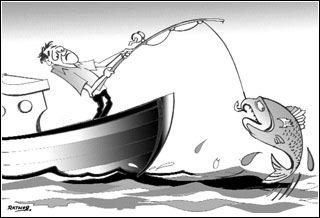 DEEP sea fishing is not in our national interest as it has created unrest among fishermen. The overfishing and habitat destruction afflicted damages like failure in transfer of technology, revenue losses and jobs opportunities since the time the foreign vessels were allowed to fish in Pakistan’s Exclusive Economic Zone (EEZ).
The indigenous fishermen have since been unable to acquire skill and means in exploiting the zone beyond 12 nautical miles. A fishing zone 12 to 35 nautical miles exclusively reserved for local fishermen — as “buffer zone” under the deep sea fishing policy — has been inaccessible to them but has been poached by the deep sea vessel under the so-called joint venture programme. The deep sea fishing carried by foreign fishing vessels since 1982 has failed to deliver goods, like technology transfer, boost in fish export and improvement in the socio-economic condition of the fishermen.
The government has admitted that the licenses of 30 foreign vessels (Chinese, South Korean and Taiwanese) were cancelled on the charge of violating the rules.
They were supposed to operate beyond 35 nautical miles of coast and within 200 nautical miles of Pakistan’s Economic Zone. But these trawlers had been catching fish much inside the minimum limit of 35 nautical miles. Moreover, these trawlers have been selling their catch harvest on ports of neighbouring Gulf States instead of bringing it to Karachi as required under the agreement.
The purpose of the policy to transfer technology and earn foreign exchange by exporting the product through its ports was lost. The long built Korangi Fish Harbour to decongest the Karachi Fish Harbour and operate deep sea vessels has since remained inoperative.
There has been resentment from the fisher-folk that the foreign deep sea operating vessels kept on selecting the fish catch of their choice and throwing back the bulk as trash into the sea. This is causing a detrimental effect on the slow sustainable growth of our marine stock.
Those who are in favour of the deep sea fishing operation by foreign and the so-called joint venture programme assert that the local wooden vessels are not effective beyond 12 nautical miles because of their size, shape, engine capacity (HP).
Their technique fails in catching beyond certain depth, thus the fish resources remain untapped. Modern vessels and techniques need to be employed for tapping these resources, which if left untapped, would be harvested by the neighbouring states or would become the right of the land-logged countries.
Recently, the federal minister of food, agriculture and livestock has asserted the government’s proposal of extending the deep sea limits from 12 to 20 nautical miles for local fishermen. This could be an encouraging move if our fishermen have the skill and means of fishing beyond 10 to 12 nautical miles.
There was no barrier for local fishermen in the past since the zone 12 to 35 nautical miles has remained open for them in the deep sea policy as the “buffer zone”.
In fact steps should be taken to enable the local fishermen acquire deep sea fishing fleet through skill, techniques and credit facilities. They should be coaxed into utilizing the infrastructure built worth billions viz the Korangi Fish Harbour, Shrimp and Fish Seed Hatchery Complex. The licenses of 30 foreign fishing vessels, permitted under the 1995 deep sea fishing policy were cancelled in September 2000 and the policy was revised in August 2001 with additional surveillance and punitive measures for the violators. The federal government has also invited tenders for the registration of deep sea vessels.
The situation remains unchanged as the implementation and enforcement agencies are same with the same fragile surveillance system prune to corruption along with the absence of fish stock assessment system for checking over fishing of marine stock. The last stock assessment was carried out some 17 years ago has now become obsolete. The Sindh provincial authorities which are not in favour of deep sea fishing are unable to manage the coastal fisheries in letter and spirit. The Sindh coastal zone has also been a victim of gross overfishing and the rampant use of gears has become detrimental for the progeny and growth of fisheries. Not only the area up to 12 nautical miles has been effected but the estuary and creeks of Indus delta regarded as a nursery for most of the commercial fish and shrimp species has become cause of degradation of marine ecosystem and habitats. The pollution, indiscriminate cutting of mangrove forest and reduced flow of Indus river into the sea are the added factors to downsliding the fish and shrimp industry especially, the Pallah and shrimp fishery — the mainstream of national economy.
The industry has been showing a decline in export earning making the target of $250 million a dream. A dismal figure of $137.737 million for 2000-01, $138.879 million for 1999-00 and $121 million for the year 1998-99 could only be recorded. The irrational and non-judicious exploitation of both, coastal and industrial fishing zones and huge post-harvest losses at ports are the main factors for dismal export figures. The new managers controlling the affairs of fishing industry in Pakistan have again failed, despite changes made at the top level. There seems to be dearth of professionalism and the dedicated approach.





























