0
0

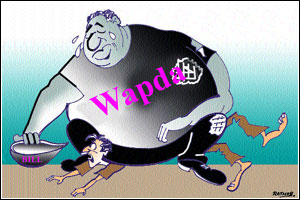 WAPDA which has been for ever in financial distress in recent years is in greater travail now because of the accumulated heavy losses and blockage of the means to set that right.
And the World Bank is adding to the pressure on the proverbial white elephant by urging it to speed up its corporatization programme and complete it by December if it wants the promised power sector loan of $ 350 million
Wapda’s latest worry is the National Power Regulatory Authority which has agreed to let it increase its power tariff by only 11 paisa per unit against the 75 paisa it had asked for originally and scaled that down later to make up for its large losses.
Gen Zulfikar Ali Khan, chairman of Wapda, finds it too difficult to accept the role of NEPRA in determining power rates and agreeing to only low increases in rate while Wapda calls for large increases in view of its total losses of around Rs80 billion, including the system loss of Rs64 billion annually. The NEPRA wants WAPDA to cut the theft and loss of power which is in reality over one-third of its output while WAPDA underrates that and says it is 26 per cent.
The heavy loss and theft of power apart, Wapda has not been able to collects its bills from many major consumers, including provincial governments, autonomous bodies, the Federally Administered Tribal Areas and Azad Kashmir. The KESC too has not been able to pay its large arrears of Rs11 billion because of paucity of funds adding to its lasting financial distress.
Wapda has also to supply free power for 120,000 of its employees all over the country and lose revenues.
And recently while the price of furnace oil kept on shooting up for long, hydel power output dropped because of the fall in the water level of the dams. And that inflated the power production cost further.
Gen Zulfikar says he wants to supply power to people at affordable rates, but he is not able to do due to official policies. Among them are the high federal and provincial taxes which are equal to almost 50 per cent of WAPDA’s revenues of Rs156 billion annually. While the federal government has refused to give up the taxes because of the stipulation of IMF that it should not give any such tax relief, the provincial governments with their financial crisis are not willing to give WAPDA any financial reprieve. Wapda wants to replace the use of the costly furnace oil with the relatively cheaper gas, but Wapda has not been able to pay its gas bills to the gas companies, which recently amounted to Rs11 billion. Interest payments on such dues had soared to Rs 15 billion, and the Petroleum Ministry has offered to write off the interest dues if WAPDA paid the principal sum of Rs 11 billion.
Wapda was, however, able to get a recovery of Rs 26 billion made through at source deduction, that is by cutting into the payments of the share of taxes made by the Centre to the provinces from the federally collected divisible pool.
The World Bank recently showed its displeasure over the poor collection of its dues from official institutions by WAPDA and asked it to collect Rs 14 billion from the defence forces, Azad Kashmir, FATA, Sindh and Balochistan.
As an example of the heavy tax payments made by WAPDA to the government Gen Zulfikar said recently that last year Wapda paid Rs 23 billion as general sales tax to the CBR. And the price of furnace oil which was Rs 5,500 a tonne on May 19 1999 had gone up to Rs 13,700. The gas supply rate in the same period had risen from Rs 82 per 100 units to Rs 189 and following the drought WAPDA was producing only 25 per cent of its power output from hydel sources and yet Wapda has increased its power tariff by only 5 per cent since 1999.
Rejecting NEPRA’s tariff increase of 11 paisa per unit Gen Zulfikar has moved the federal government to set up a high powered committee to examine NAPRA’s decision and agree to the higher rates asked for by Wapda.
Wapda finds that if neither the tariff is increased nor the heavy federal and provincial taxes reduced, Wapda will face acute financial distress. Nor can it complete the corporatization programme by December and get the promised power sector loan of $350 million from the World Bank.
Meanwhile Wapda is making its long withheld payment of Rs 5.7 billion to the HUBCO, and has made the second tranche payments of Rs 1.5 billion now.
Wapda argues the government is being unfair to it in the fiscal sector as the fiscal relief it is asking from the government is the same as has been given to private sector power companies. But the government was denying to its own outfit what it was giving to the private sector companies. In such an environment corporatization of WAPDA may not do great good to the consumers who need less expensive power.
Of course, fuel for power production can become cheap if Wapda and the KESC could switch over to gas from too costly furnace oil. But while enough gas is available for sometimes a great amount of investment has to be made to bring the gas from the wells to the gas company’s grids and then supply it to Wapda and the KESC units. And that will take time in the present context. Meanwhile the OPEC is trying to shore up oil prices by cutting down production by 1.5 million barrels a day. Russia too has agreed to work with the OPEC to hold up the prices. But the cut is not a large one in view of the global recession and fall in demand for oil. Hence the day OPEC decided to cut output . The Brent crude in London dropped by two dollars a barrel to $19. Earlier the OPEC has regarded $18 a barrel a fair price, but after the prices began soaring and touching $32 the OPEC members talked of $22 to 28 a barrel as fair price.
The other happy development in the power sector is the fall in the exchange rate of the dollar instead of the previous frequent rise, but Wednesday’s rise in the exchange rate of the dollar by Rs 2 to touch Rs 61.20 was disturbing.
Gen Zulfikar had earlier sought permission for automatic increase in power tariff in keeping with the rise in furnace oil prices. The government did not agree. The prospect is that the power tariff may go up along with the rise in furnace oil prices but may not come down when the oil prices come down and Wapda may argue it has large accumulated losses to make up.
The government on its part has been wanting to jack up the power tariff by imposing a 15 per cent sales tax at the consumer end. So it has been showing a 15 per cent GST on the power bill as well as a 15 per cent gas adjustment — meaning zero sales tax, which is described as an official subsidy. In fact it is zero rated tax, but if the power rates come down as a result of a fall in world oil prices the government may impose the hefty GST and boost its revenues.
But the price of power coming down depends not only on the world oil price, particularly of furnace oil, in winter the period of its heavy demand in the Western world but also on the exchange rate of the rupee.
And even if gas is substituted for furnace oil increasingly that may not bring great relief as the price of gas is due to be pushed up and up and brought on to international levels. So the power consumers have small opportunities for relief while the gas companies, the government and the power producers want to get far more out of them.
Meanwhile, NEPRA wants Wapda and the KESC to slash the heavy power theft and large technical losses so as to boost their revenues and reduce their deficit and the power rates. And that is proving to be too slow a process in spite of military rule and the power production being brought under military officers with vast powers.
The right solution may mow be appointing a ministerial level committee to examine the problems of Wapda and the KESC in detail and come up with the right recommendations which are given prompt effect.