



 0
0

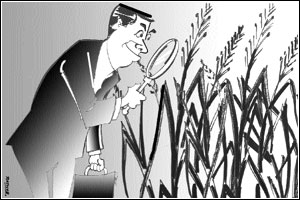 WHEAT is sown on 220 million hectares around the world with 600 million tons production — an average of 2700kg grain per hectare.
China sows wheat on around 30 million hectares, followed by the Russian Federation, India, the USA, Australia, Canada, Turkey and Pakistan. As far as the highest yield is concerned France produces 7200kg per hectare as it has much longer growing season of winter wheat. It is rather more appropriate to compare our wheat grain yields with the countries of similar climatic and eco-zones, like Mexico and Egypt. Their yields are much higher, owing both to the genetic constitution of cultivators and the environment provided to them to express their biological potential.
Since Mexico and Pakistan are located in analogous ecological zones, therefore, introduction of Mexican varieties in the country in sixties ushered an era of green revolution. But unfortunately, the pace of development could not be maintained for long and we now lag far behind the Mexican yields which produces 3900kg of wheat grain per hectare as compared to Pakistan’s 2491kg,in 1999 being the best season. According to the FAO statistics for 1995, spring wheat growing countries had fantastic yield Egypt by producing 5422kg grain per hectare and the Indian Punjab producing 4090kg. Even India leads us in average yield by producing 2559kg.
In Pakistan, wheat is cultivated largely (around 80 per cent) in irrigated areas, whereas the rest in rain-fed areas. The yield and production in latter part of the country is controlled by rains during the growing season, which are usually erratic. Hence yields are much lower during the season of low precipitation.
There are three kinds of wheat, the long duration, medium and the short duration varieties. The yields usually start declining after November 20, at the rate of 20kg per day. Hence, efforts must be made to plant it at optimum time. In cotton areas the sticks are used as fuel in domestic household. Big heaps of cotton sticks can be witnessed along the roadside and in the villages. There is a need to educate the growers on burning sticks. To restore the soil fertility at least 80 per cent sticks may be buried in soil and to enhance the decomposition, half a bag of urea per acre may be incorporated in the soil after the stick burial.
In case wheat sowing is delayed owing to late maturity of cotton, wheat may be sown in the standing crop, if there is low or no incidence of weeds. However in rice tract, wheat should be sown on proper time, immediately after the crop harvest. In rice zone a sizable area must be brought under the legumes, chickpeas and lentils production. It is not difficult to reap their yields up to 1000kg per acre, which will bring more finances to the growers as compared to raising wheat.
Adequate quantity of nitrogen, phosphorus and potash may be applied to harvest maximum grain. If phosphorus is added adequately it will help to realize good harvest and the following cotton crop will utilize the remaining residual phosphorus, without adding more of this element to cotton. There are three main factors which contribute towards low wheat yield, the sowing time, prevalence of weeds and the irrational use of fertilizers.
In irrigated areas, the crop is generally sown either after the harvest of cotton or paddy. In most cases farmers neither add organic matter nor add manure to maintain fertility, thus resulting in low yields. To sow wheat at optimum time, the cotton breeders in collaboration with the agronomists must try to reduce the life span of crop without hampering the yield and deteriorating the quality of lint. This will have substantial saving on the management of cotton.
As far as the weeds are concerned it is estimated that the decline in wheat yield ranges from 15-40 per cent or even more in some cases, which indeed, is a great loss towards food self-sufficiency. In certain localities, it appears as if, wheat is an unwanted and obnoxious plant. It is negligence on the part of extension workers and the grower, himself. The extension workers with the help of farmers may try to delineate the areas of high infestation of “Dumbi Sitti” and wild oats. The farmers in such areas may be advised to control them through agronomic practices or herbicide treatment or removing the weed plants just after earring because at that stage it is easy to differentiate between both the weed and wheat plants. If these weeds are not controlled now they will spread like a wild fire in the coming years in whole of wheat areas. The weeds have the capability to produce large quantities of seed, which is always shed before wheat harvest, increasing the infestation at an alarming pace. These two weeds along with “Sitti” can be used as biological warfare in agriculture.
On the other hand in Barani areas “Pohalli” is quite a common weed, which can be easily seen while travelling by air, road or rail after the harvest of wheat. The abundance of which is a main factor for low yield in the area. The Pohalli remain green much after the harvest of crop which is the best time to eradicate it by uprooting and burning. Two or three exercise will help to whip out the weed in Barani areas. This year may be declared a Pohalli eradication year. The road sides and sides of rail tracks may also be cleared of it.
The pace of yield of wheat increase per hectare during the past 20 years has been awfully poor. The population growth however, over whelmed the increase in yield per unit area therefore; the enhanced demand of wheat consumption was met by bringing more area under crop, which was not a good omen as how long increase in area under crop shall come to our rescue. This problem has to be tackled through serious and wise planning and execution. First of all we shall have to get rid of non-technocrats from the lowest level to the highest in the ministry of food, agriculture and livestock and induct able, selfless agricultural scientists. More funds have to be infused for research and transfer of technology. The general public need to be motivated to diversify the so-called dietary pattern which is imbalance, to reduce the unnecessary burden on wheat, besides substantially boosting the yield per unit area by placing the area under oil seeds, vegetables, fruits, pulses and flowers. Some area may be brought under fodder to raise the animals for milk and meat production. Last but not the least we ought to arrest population growth. The improvement in agronomic practices will equate Pakistan with Egypt. There are many stored grain pests which destroy a substantial quantity of produce. Efforts may be made to eliminate the losses.





























