0
0

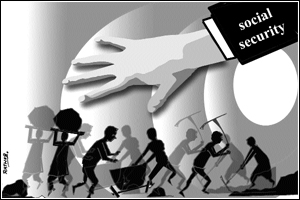 MINING activity is regarded as one of the most hazardous occupations, because mine workers are exposed to many kinds of risks which may range from regular health problems to fatal accidents.
Besides, the mining activity usually takes place in the far-flung and undeveloped areas, where mine workers may be living without clean drinking water and other basic amenities of life. In this perspective, two very elaborate laws— the Mining Act and the Workmen’s Compensation Act— were simultaneously brought on the statute book in the year 1923.
The Mining Act, 1923 is a comprehensive law in so far as it provides for regulation of working conditions in mines, safety measures to be taken and other necessary facilities to be made available to workers. This is to be ensured through mechanism of inspections entrusted to chief inspector of mines and the mining board to be constituted under the law. The Act also contains explicit provisions regarding the health and safety of mine workers. According to section 28, the register of employees shall be kept on a prescribed form and its maintenance will be mandatory, as no person shall be employed in a mine until the particulars required have been recorded in a register.
The Workmen’s Compensation Act, 1923 provides for payment by employers of a certain amount of compensation to their workmen, if they are injured in an accident while on duty. The Act applies to vast categories of workers including mine workers and it lays down that if a worker receives an injury or suffers from an occupational disease or dies, while at work, the dependents will receive compensation from employer. The amount of compensation varies from case to case and at present in case of death or permanent disablement it is Rs100000. It also provides for permanent partial disablement as well as permanent total disablement. The Act is implemented by provincial governments which are empowered to appoint commissioners in this regard.
Despite all the essential provisions envisaged in the Mines Act, 1923 regarding the health, safety and working conditions of mine workers and the criteria enunciating the compensation for partial and total permanent disablement alongside the death compensation in the Workmen’s Compensation Act 1923, both these Acts fall far short of providing social security coverage to mine workers, probably for the reason that the concept of social security was developed later on. Accordingly, when the Social Security Ordinance 1965 was passed, it should have been extended to mine workers. But this was not done and the mining sector was excluded deliberately and the only urban class workers who were employed in factories in the urban areas were provided the coverage.
However, just after two years of the introduction of the Social Security measures for the vocal urban sector, it was thought expedient to provide for basic amenities of life to mine workers at a modest scale. With this view in mind, Exercise Duty on Minerals (Labour Welfare) Act 1967 was promulgated which aimed at providing housing facilities besides the establishment of general welfare fund under which transport, dispensaries and other allied facilities were to be provided.
The Act envisaged establishment of a mines labour housing board and a mines welfare board. It is a fact that some facilities under this act have been provided by the provincial governments excepting NWFP where initially due to the misunderstanding on the nomenclature between the federal and provincial government and since 1973 due to internal administrative difficulties of the provincial government, no facility could be extended.
During the 1970s, two very significant labour welfare-oriented laws were brought on the statute book. Firstly, the Workers Welfare Fund Ordinance 1971 and secondly the Employees Old Age Benefits Institution Act 1976. The first act aimed at providing specially the housing facilities for working class who were covered under the definition of Industrial Relations Ordinance 1969 and so far residential facilities worth Rs10 billion have been provided.
The objective behind EOBI Act 1976 was to cater for the old-age benefits such as old-age pension, invalidity pension, survivors’ pension and old-age grant. A total sum of more than Rs7 billion have been distributed amongst the eligible workers so far. Both these acts were made applicable to the mine workers, but studies conducted reveal that mine workers have received hardly any benefit under these schemes.
As a background to the Social Security concept which was originally envisaged under the ILO conventions, it may be stated that it was much more comprehensive than what was prescribed in the Social Security Ordinance 1965. It may be clarified here that conceptually, the above two benefits, namely housing and old-age pension should have formed part of the social security, but incremental approach was adopted for the reason that it should not become unbearable for the employers in the country. However, as many as ten cash benefits are enumerated under the existing social security law which are to accrue to the employees in addition to the basic Medicare facilities and these are as under:
(1) Sickness benefits,
(2) Maternity benefits,.
(3) Injury benefits,
(4) Disablement pension,
(5) Disablement gratuity,
(6) Survivors pension,
(7) Death grant,
(8) Medicare during sickness and maternity,
(9) Medicare of dependents,
(10) ‘Iddat’ benefit.
During the past 35 years, the institutions of Social Security have put up an impressive show, mainly because of the fact that the organisation of these institutions was conceived on tripartite basis. Besides, the government nominee as head of the organisation, boards of governors were duly represented by employers and employees. Moreover, the funds generated by these organisations did not form part of the public exchequer and were hence outside the clutches of the bureaucratic red-tapism.
In Punjab, presently where the number of employees covered under the social security exceeds half a million workers, the total annual collection is about Rs1,000 million. The estimated per head expenses has been worked out around Rs2000/. In Sindh the per capita cost of social coverage is about Rs2,234/- and the number of secured workers is 194,400 whereas the total yearly income is about Rs 442 million. In NWFP, this expenditure is in the range of about Rs760 per head and the total number of workers benefiting is about 42000 only. Balochistan has the highest per capita expenses and this is around Rs3395 and the total number of workers is hardly 7000.
An analysis of the above expenditure suggests that on one hand it may vary from head to head in the province, more than 50 per cent of expenditure is incurred on medicare which includes simple treatment to the cardiac surgery inside the country. The second most expensive item is cash benefits which are disbursed under the ten categories.
As far as collection of social security is concerned, it is levied at the rate of 7 per cent of the wages of the workers. If the minimum wage is taken at Rs3000 per month, then this contribution works out to be Rs210 per month and Rs2520 per annum. This shows how the expenses incurred on security coverage are being met, rather there are chances of saving on the part of the institutions at provincial level. Now if mine workers are to be socially covered, the question is, will mine owners be ready to contribute at the rate of 7 per cent of the wages earned by workers. Mine owners have often taken the stand that they are unable to pay this much amount as the economic returns due to the fluctuating and downward trend of the coal prices in the country do not leave enough cushion for them. They also argue that the excise duty being charged at the rate of Rs1 to Rs5 per ton is legally meant for this purpose. They also pay the compensation of Rs100,000 per worker in case of accidental death and are under the obligation to make other payments under the workmen’s compensation, Act 1923.
The alternate solution being suggested is that the excise duty be abolished and replaced by the imposition of social security contribution. But then the difficulty is that almost none of mine owners maintain the register to which we referred at the beginning. In fact they have resorted to contract system so as to avoid the maintenance of this mandatory register and they easily take shelter under the law through courts. As a result of this, even EOBI coverage could not be extended on mine workers despite express provisions in the statute, though a cumulative amount of more than Rs 7 billion has been disbursed as pension and other benefits under the EOBI scheme in the country.
Thus we are left with the only alternative to consider the phased strategy of extending social security and remaining within the range of the excise duty rates which is presently Rs2 per ton. It has been calculated that if the rate of excise duty remains the same and is also charged on tonnage basis, as otherwise the mine owners are not ready to pay, then the collection per worker comes to hardly Rs250 per annum, and if the present rate is revised up to Rs5 as already covered under the law, it would yield about Rs600 per annum. In that case, the question would be, is this amount sufficient to sustain the social security coverage which ranges between Rs800, the lowest in NWFP and Rs2234 in Sindh or the weighted average of which comes near Rs1500 per annum.
Accordingly, it is proposed that the social security coverage be extended in phased manner. In the first phase only medicare should be provided through the existing infrastructure and logistics of the social security. If any new infrastructure such as dispensaries, ambulance and mobile vans are to be provided, that should be arranged from the workers welfare fund for the purpose. In any case, initially the social security services would have to be augmented from the workers welfare fund till the revised rates catch up or come nearer the present rate of social security which is 7 per cent of the wages and when translated in rupee terms it works out to be Rs2520 per annum for the minimum wage of Rs3000 per month. Similarly, with the extension of EOBI Act, the Workmen’s Compensation Act 1923 will become inapplicable as provided under Section 81 of the EOBI Act and the four benefits under the EOBI will automatically become available to the mine workers.
Under these circumstances, the probable solution likely to succeed is that the social security net be extended in phased manner. In the phase only medicare be provided by continuing with the present rate of Rs2 per ton as social security charges. But this amount should however be collected under the nomenclature of social security charges by amending the existing Social Security Ordinance and abolishing the Excise Duty (Labour Welfare) Act 1967, which even otherwise is a misnomer.