0
0

A case for developing a hill station
SINCE the birth of Indus civilization, Larkana has been at the centre of pre-historic and historic monuments. The canals, tombs, mounds all have a tale to tell. Between Balochistan and Sindh on the Khirthar mountain within the Larkana district lies the Kutti-ji-Qabar (dog’s tomb).
A folklore is related about Kutti-ji-Qabar. The mountain peak is named Kutti-ji- Qabar after a legend. The story goes that a master gifted his dog to his friend out of love. But the friend, after a while, let the dog free. The dog returned to his master, who in turn suspected him of fleeing from his friend. Not knowing the real reason behind the dog’s return, the master rebuked him. On receiving this ill treatment from his master the dog died, on the spot, of shock. When the master came to know the truth, he buried the dog at the highest mountain peak as a tribute to his loyalty. The site is, in local tradition, a symbol of loyalty .
It is included in the Sindh Annual-1978 report, which includes it in its description of the Larkana district’s physical features as under:
“The most elevated peak known as “kutti-ji- Qabar” is 2,064 metres above sea level.”
H.T Lambrick mentions it in Sindh: a general introduction as follows: “Immediately to the south of the Daryaro plateau, the massive peak of Kutti-ji-Qabar rises to 6,877 feet, nearly a thousand feet above the general level of this part of the range — afar seen landmark in upper Sindh”.
During the raj many British officers such as Mr Mansfield, the 5th commissioner of Sindh, and Sir Charles Olivant, the 14th commissioner of Sindh, visited the site in 1864 and 1894, respectively.
The dog’s tomb can be turned into a spot for recreation with a sanatorium for local and foreign tourists. Below the dog’s tomb, to the north, is a plateau known as “Daryaro” which is 1,500 feet above sea level. It was proposed as a site for a sanitorium by the British whose officers visited it from time to time.”Daryaro” about 2,000 metres in elevation, with its alluvial to sandy soil, was deemed to be the only possible location for a sanatorium.
Because of its physical and geological location and fair weather, the plateau could have been made into a hill station. It would require much funding and planning. Tragically, however, the archeological department of Sindh has neglected the site.
The district coordination officer, Mohammad Hashim Leghari, recently had convened a meeting of elders of the area — the Chuttos and Chandios who live around the belt. Intellectuals, students of history and officials at Kutti-ji-Qabar participated in the heated debate. It was noted that the “Daryaro” plateau, a valley between the mountain ridges, provided pasturage for large flocks of sheep, goats and other domestic animals. Green with grass it could be used for cultivation.
A team of revenue officers posted at Kambar and around had tried to create an approach to the site. A comprehensive report about the possible approaches was prepared in May 2001, suggesting four possible routes to reach Kutti-ji-Qabar. The routes were either hilly, kuthca, and of different distances. One of the routes, 10km through hilly terrain from Rahoo-jo-Aitho to Sita-ji-Dath, followed by a two-hour risky camel ride, leads the visitors to the area.
The three other routes suggested were — Kambar to Gaibdero; Gaibidero to Rahoo-jo-Aitho; Rahoo-jo-Aitho to Sita-ji-Dath and Sita-ji-Dath to Kutti-ji-Qabar. It was decided for a committee, headed by Dr Dur Mohammad Pathan, to finalize the report after studying its pros and cons. It is yet to be prepared.
Former prime minister Benazir Bhutto had wished to develop the area not only as a hill station but because of its location and climate to make it a summer capital of Sindh as did former Sindh chief minister Syed Abdullah Shah. But the dream remained unfulfilled .
The Balochistan government has annexed a portion of the area that belonged to Larkana into a ‘Karakh’ union council in the Khuzdar district.
The new district government of Larkana should protect the original boundaries of the district and also implement plans to uplift its constituencies. It can allocate funds to convert the site into a hill station and later could establish a sanatorium and protect its boundaries.
Law unto themselves?
TO be or not be, is the question then. Is it better for police to serve under civil authority or to be a law unto themselves? There has been a rare national consensus for quite some time now that the police and policing are not what they ought to be. The need for reform is a mere corollary. Not to be left out, the police, too, have joined in the clamour. On Friday, the governor approved an expenditure of Rs100 million in this direction. Of course, the consensus does not go very far. The need for transparent recruitment procedures, adequate training, attractive working conditions, infra-structure, community support and security of service is obvious. Beyond that, there are as many assessments of what exactly is wrong with the police as there are concerned citizens. It is said the system in vogue is a relic of the colonial era suited only to colonial needs. That with certain adjustments the system is still serving several nations, including nations that have not known foreign rule for centuries now, is forgotten, or ignored.
It is likewise said that political patronage and bureaucratic control have been the corrupting, disabling influences. That these have provided the only safety valves at the operational level against anarchic outbreaks, is likewise ignored.
The mantra touted by our reform-minded policemen is: free police of all kinds of administrative control by individuals or institutions ‘foreign’ to it. Independent commissions acting as monitoring bodies are proposed as a guarantee of ‘democratic control’. There is no discipline like self-discipline, the argument goes, and a comparison is made to the armed forces, the only service free of civilian intervention.
The formula is far from reassuring for the unprivileged citizens. Attitudes change too slowly to permit much optimism in this regard. Even the proponents of the plan expect to see the ‘reformed force’ after several generations of the present one have been replaced by new recruits.
The separation of the Executive and the Judiciary, brought about by implementation of a landmark Supreme Court judgment, had weakened the police-magistracy link. With the abolition of the district magistrate’s office and the executive magistracy, the police have tasted new freedom. The developments have, predictably, been unwelcome to the district management group of civil servants which has been openly criticizing them and pointing out the problems caused by the transition. Catastrophe and doom are routinely prophesied.
The police, equally predictably, have welcomed the changes. Their only apprehension has been the implementation of a proposal under the original devolution of powers plan to make them subordinate to the district Nazims. This has not happened yet, primarily because heeding the DMG’s warnings and foot-dragging, the government has relented. In principle, the decision stands. Police reporters are now saying, however, that the police are determined to resist being put under the Nazim, the district coordination officer or the Nazim through the DCO.
Is the police performance and attitude since Aug 14 anything to go by? The anti-US demonstrations have been handled with admirable restraint but credit for that may be due elsewhere. The teachers’ demonstration was treated quite differently but then some people would say the police regard teachers as a rival control institution. Some even say there may have been some personal element there. So the evidence, as they say, is not really conclusive.
The ongoing drive against illegal weapons is no better, no worse. And the crime scene?
There was a report last week about a newsman having been robbed by uniformed men — he believed precinct policemen — at gunpoint. The SHO was not convinced and an FIR was not registered immediately. An FIR was, on the other hand, registered promptly by the Sabzazar police on an assault and gang-rape complaint involving uniformed men who claimed to be police officials. Isolated incidents? One hopes.
It is reports like these that fuel the citizen’s fear of a police force answerable to nobody. Accustomed and resigned as we are to petty corruption, apathy, inefficiency, and occasional intimidation, rape and robbery are simply too much.
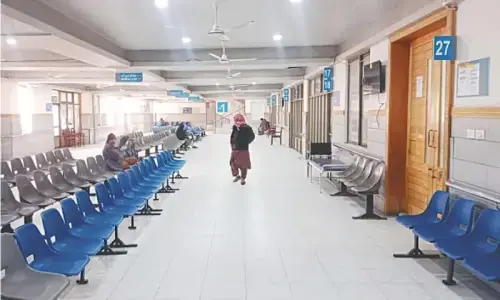
A Dawn reporter spent nearly four hours at the Punjab University a few days ago to collect a letter verifying his BA degree.
It would not have required so long but the relevant notification took some time tracing.
The time spent sitting in the assistant controller’s office afforded invaluable insight into the working conditions there. His impressions:
“There is an urgent need for more staff to handle the large number of requests for services like verification of degrees, certificates and marks sheets and corrections in the documents. “There is an urgent need to better organize the record. According to the assistant controller of examinations himself, going through PU record was like looking for something under the sea.
“There was admiration for the ACE and a retired diabetic who had been told the certificate he needed would be available at 1pm and had to wait for it until 3pm, said he appreciated the way the officer had been dealing with requests and complaints since morning. “The ACE, now signing some degrees, nodded his thanks but pointed out that his job required attention to detail. The degrees had to go to all corners of the world. Ideally speaking, he said, he should be sitting in a quiet room. ‘At least, I should not be talking to you,’ he said. He said there was no room for a mistake as every mistake meant a degree form wasted. A form costs Rs5.
“Yet, people kept turning to him for advice on how to proceed with different cases and some applicants got impatient because they needed the documents urgently. A clerk was heard muttering to himself that he was expected to do the job of five people. Three or four people surrounded every clerk’s table in the hall with various requests and complaints, each insisting to be heard first.
“At 3:30pm a senior PU officer phoned to say he needed a report listing all degrees issued since 1994. He said he wanted it at his table, first thing in the morning.
“A very patient and extremely courteous ACE said while he and his staff were committed to doing their job, they expected the applicants to understand their problems.”
PU authorities, too, might show some understanding.
A test given recently at a local hotel on BBC’s behalf was delayed by nearly 40 minutes to avoid potential distraction on account of another test in progress at the time in the adjoining hall.
THE US Secretary of State, Colin Powell, was in Pakistan for talks aimed at cementing the international coalition against terrorism. Before he left, a satisfactory meeting of minds was apparent between the two governments as he affirmed, among other things, the centrality of the Kashmir issue in Pakistan-India relations. Once in India, however, Secretary Powell said India and US were natural allies. He also talked of fighting ‘terrorism’ against India with the same determination as that against the US. Our beloved, a Persian poet had complained, agrees with everybody. With us she drinks wine and with the ascetic prays.
MUSHAHID Husain Syed was again on PTV last week. Some people could not help noticing that Syed Iftikhar Gilani was another guest and Syed Talat Husain the compere. Then somebody pointed out that their names may have been proposed by Syed Anwar Mahmood and approved by Syed Pervez Musharraf himself. — Onlooker