0
0

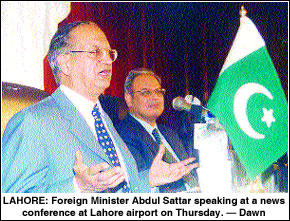 LAHORE, Oct 11: Pakistan said on Thursday that implementation of the UN resolutions about the perpetrators of the Sept 11 terrorist attacks on the United States was the only solution to the present crisis and the Taliban government should go by the world body’s decisions and bring Osama bin Laden to justice.
Foreign Minister Abdul Sattar said at a news conference immediately after his return from Qatar, where he represented Pakistan in the OIC foreign ministers’ conference, that Pakistan adhered to the UN resolutions and wanted the Taliban to follow suit. Islamabad’s position on the subject was quite clear and principled, he said, adding: “We can’t be hostage to any (other) country’s decisions.”
He regretted that the Taliban had driven themselves to a corner.
When it was pointed out that the US had indicated that it might expand its operations against terrorism and target some other countries after Afghanistan, Mr Sattar said the resolutions in the light of which strikes were being carried out did not make a mention of expansion.
As for Pakistan’s stand on the issue, he said: “Our policy is cast in the mould of the UN resolutions.”
When a reporter invited the foreign minister’s attention to US President Bush’s statement that he had not given any assurance to anyone that ongoing bombing campaign in Afghanistan would be a short one, meaning thereby that President Musharraf’s claim on the subject stood contradicted, he said the difference is in the mind of the listener.
He pointed out that President Bush had very clearly stated that action against Afghanistan could be shortened if Osama was brought to justice.
This operation, the minister said, was limited in purpose and once its target was achieved — the handing over of Osama — it would come to an end.
As for the new list of people wanted by the US for their alleged involvement in terrorist acts, the foreign minister said the list did not suggest that all wanted people were in Afghanistan.
Asked if he regarded Osama as a terrorist, Mr Sattar said the Saudi dissident had been named in two UN Security Council resolutions.
The minister told a questioner that the Qatar conference had received no letter from the Taliban government appealing to the Islamic countries to play their role to bring an end to military strikes on Afghanistan.
Replying to a reporter’s question about Pakistan’s role in a situation when the people of Afghanistan were dying as a result of incessant American attacks, Mr Sattar said Pakistan was not the only Islamic country and all 57 members of the OIC wanted an end to terrorism from the world.
He said the UNSC had decided that terrorists should be brought to justice and this was in the interest of Afghanistan, Pakistan and other countries.
He said it was a fact that Afghanistan was facing some collateral damage, but the way out was very clear — implement the UNSC resolution.
Mr Sattar said unfortunately some foreigners had come to Afghanistan and were not leaving it despite a call from the ulema.
“To save the innocent people, it is imperative that the accused (of terrorism) should be brought to justice.”
When questioned in which court Osama could be produced, the minister though so far no debate had been held on the subject, for justice it was important that the tribunal was impartial.
He said international tribunals had been set up to try former Yugoslav president Slobodan Milosevic and the accused of the Lockerbie case.
In his opinion if the Taliban leaders had taken up the matter with the UN, some solution would have been reached by now.
Asked how would the fallout of the existing crisis affect Pakistan’s position on Kashmir, the minister said the joint communique issued at the OIC foreign ministers’ conference had clearly differentiated between terrorism and a freedom movement.
He said the UN General Assembly was also seized of the matter and whatever definition of ‘terrorism’ was agreed upon, Pakistan, like the rest of the world community, would accept it.
He said there had to be the same yardstick for all United Nations resolutions as double standards would compound problems.
To prevent wars, he said all disputes should be settled in accordance with the international law and the UN resolutions.
About the US indifference towards Pakistan in the past and the possibility of the same attitude in the future, the minister said realistically speaking interests of an objective situation were the major determinants of bilateral interests.
“We don’t visualise that our relations with the United States will always be good (as at present).”
About Secretary of State Colin Powell’s visit to Pakistan, he said it might be helpful in enhancement of the assistance Islamabad wanted for poverty reduction.