



 0
0

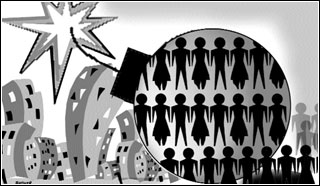 THE population census in Pakistan has a chequered career. According to the first census held in 1951, the total population of Pakistan was 33.8 million.
The estimates initially put forward in 1961 recorded an increase of 2.4 percent. According, the population stood at 42.9 million. The planning commission however rejected these figures on the ground that there was under enumeration in the age group of 6 to 13 years. The commission therefore estimated a population of 46.2 million, which was an increase of 7.5 per cent over and above the estimate of 1951.
As a result of new adjustments, the population growth rate during 1951 to 1961 went up to 3.2 per cent. The population kept on growing at an annual rate of 3 percent during the intercensal period 1961-72 and continued to be round about that level even until 1994-95 when it declined to 2.9 percent.
It is however worth mentioning that the annual growth rate of 2.6 percent as a revealed by the fifth population and housing census 1998 is still above the standard world average of 1.5 percent.
Population growth in different countries is determined by three important factors viz., fertility, morality and migration. Developing countries tend to have high fertility rate and Pakistan being one of them is no exception. A cursory glance at population statistics reveals that after Maldives and Bhutan, Pakistan has the highest fertility rate in the whole of south Asia (see, table 1). At present, the crude birth rate (CBR) as estimated by UN stands at 38.9 per thousand whereas the total fertility rate (TFR) in Pakistan veers around 5.5 per woman. the prevailing fertility conditions in Pakistan are indeed alarmingly high even exceeding those in Bangladesh. the estimated CBR in Bangladesh currently figures around 26.8 while the TFR stands at 3.8. It is indeed amazing that Bangladesh, which was East Pakistan in 1961, shared with Pakistan population growth rate of 3 per cent, but it declared growth rate of 2.3 per cent at the time of its independence. The current annual population growth rate in Bangladesh is 1.9 per cent, which is a remarkable achievement as far as controlling the size of its population.
Besides fertility rate, the level of crude death rate (CDR) is also an important factor influencing the size of population in a country. Increasing population refers to the phenomenon of birth rate exceeding death rate. In Pakistan, while birth rate keeps spiralling, death rate has considerably declined which in turn has given rise to the spectre of population boom. the estimated CDR in Pakistan currently figures around 10.0 per thousand, which has gone down from 31.2 per thousand in 1941. In addition to this, an important indicator of mortality is infant mortality rate (IMR) which at present is 84 per thousand in Pakistan. It is unfortunate that the rate of mortality among infants has been constantly on rise in Pakistan. However, in view of the importance of IMR as an index of socio-economic development, the government of Pakistan in the recent past has launched vigorous campaigns to reduce infant and child mortality. this will however result in further lowering of the! crude death rate.
In addition to a natural increase in population, which implies births out-numbering deaths, the population size of a country is also influenced by net migration particularly when the number of immigrants exceeds the number of emigrants Pakistan has been confronted with the problem of massive refugee influx, which continued unabated right from its establishment in 1947 down to the present age. The problem took a turn for the worst in the post-1979 period when, because of the Russian invasion of Afghanistan and the civil war, nearly 3 million Afghan refugees crossed over to Pakistan and were accommodated into tented villages along the whole Pak-Afghan border. In addition to high number of Afghan refugees presently residing in Pakistan, there are host of others such as Kurdishs, Burmese, Sri-Lankans and Iranians sneaking into the country turning it into a refugee paradise. This has certainly added grave dimensions to the population problem of Pakistan.
The cumulative result of the above factors is a high figure of population which adversely affects the ratio of population to social sectors like those of literacy rate and health care etc. It is in this connection that one can easily find out the nexus between increasing population and decreasing pace of socio-economic development. The rate of development in relation to a few important aspects of social and economic activity in Pakistan can be assessed by analyzing the following indicators:
Firstly, the optimum population rate (OPR) or the ratio of working population to total population currently stands at around 29 per cent which shows a dependency rate of above 70 per cent. This compares very unfavourably with 35 to 40 per cent dependency rate in the developed countries.
Secondly, Pakistan also finds herself in the throes of an acute unemployment crisis. The total labour force is 38.6 million, growing at an annual average rate of 2.9 per cent since 1993. The labour force participation rate is 28.7 per cent. Agriculture is a major source of employment accounting for about 48 per cent employment followed by personal services, wholesale and retain trade. The open unemployment in Pakistan is estimated at 6.10 per cent with break up of 7.10 percent in urban and 5.7 per cent in rural areas.
Thirdly, the literacy rate in Pakistan is estimated at 45 percent, which shows substantial improvement over 26.2 per cent in 1981. It is however still low as compared to many other countries at similar stage of economic growth.
Fourthly and lastly, the health facilities in Pakistan are quite inadequate despite the fact that government is running a nation-wide network of medical services. According to the economic survey of Pakistan 1997-98, the infant mortality rate is still the highest in the world, while other social indicators also reflect poorer performance in comparison with other low and lower middle-income countries as shown in table 2.
The facts cited above clearly point towards the existence of population problem, which currently seems to defy all attempts aimed at realizing the goal of sustainable economic development in Pakistan. The redeeming feature is however the density of population in Pakistan which being the lowest in South Asia underlines Pakistan’s potential for development as shown in table 3.
The relationship between population growth and sustainable economic development is generally analyzed with reference to the population carrying capacity of a country. The population carrying capacity of an economy is defined as the maximum increment in population allowed by the national savings with constant per capita incomes. In an economy like Pakistan, the relevancy of such concept of sustainable development is conditional to the generation of reasonably high growth rates, aiming at reduction of poverty and generation of sufficient employment opportunities.
An important mode of enhancing the population carrying capacity of Pakistan’s economy is to keep the population at an “optimum level”, which means the ideal number of people that the country should have considering its resources.
Since the optimum level of population aims at maximization of output per head of the total population, it is desirable not only for accelerating the pace of economic development, but also for improving the living standard of an average citizen, keeping in view the constrains of existing technology and resource endowment.
In short, there are at present a number of indicators pointing towards the state of over population in Pakistan. In view of the problems emanating from it, there is an urgent need to slow down the growth of population before the situation really gets out of control.



























